Israel has intensified its attacks on Lebanon this week, hitting areas outside of Hezbollah's control on Tuesday.
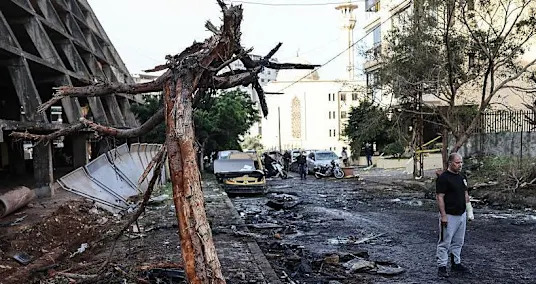
Strikes without warning hit a vehicle north of Beirut and the Jnah neighbourhood in the heart of the capital.
Attacks also continued in the city's southern suburbs and the country's south, both where Hezbollah has a strong presence.
A building was destroyed on the road to Beirut's airport after an evacuation order, and in the south, a strike hit a health facility, killing a paramedic, according to Lebanon's health ministry.
Israel's military said it had hit Hezbollah infrastructure in Beirut and killed a senior commander and another senior figure from the Iran-backed armed group.
Hezbollah joined the ongoing regional war on 2 March, sending missiles towards Israel, after the US and Israel attacked the armed group's ally Iran on 28 February.
Israeli attacks have kept bombarding Lebanon as its troops have moved into the country's south.
On Tuesday, a vehicle was targeted in the Mansourieh area, a predominantly Christian residential neighbourhood north of Beirut.
Meanwhile, the Jnah neighbourhood in the heart of the capital was attacked after midnight. The Lebanese health ministry said the Al-Zahraa Hospital had received and treated "a number of those injured in the air strike".
Hassan Jalwan, who lives near Jnah, told AFP he heard several "big explosions" overnight.
"Nobody knows what's happening," he said, adding that "displaced people have been sleeping in the open" in the area.
The Dahieh neighbourhood to the south of Beirut, where Hezbollah has a strong presence, continues to be a target. A building was destroyed on Tuesday in Ghobeiry on the road to the airport following an evacuation order.
Also on Tuesday, Lebanon's health ministry said at least seven people had been killed by Israeli strikes in the country's south, including the paramedic.
The number of health workers who have been killed since the start of the war has now reached 53.
Earlier, the Lebanese army cleared its last positions in the south, pulling out from Ain Ibel and Rmeish villages a day after an army checkpoint was hit and a soldier was killed by an Israeli air strike, according to the Lebanese Armed Forces. The Israeli military has not appeared to have commented yet on the reported death.
However, some residents of the villages refuse to leave.
In the predominantly Christian village of Rmeish, Father Najib Al Amil appeared in a video on social media, where he said: "There is grass and soil. We rely on God and will stay in our village. We either all die together and lose our land or live and our villages will live with us."

Israel has announced its decision to control large swathes of land in southern Lebanon - up to the Litani River, about 30km from the border with Israel - to create a buffer security zone.
Israeli Defence Minister Israel Katz said Israel would keep security control over the territory even after the end of the current war against Hezbollah. The plan has drawn criticism from the UN.
Hundreds of thousands of people have been forced to leave the south, but there are still tens of thousands who have refused to go.
Supply lines to the south have been cut by Israel targeting bridges and infrastructure, making villages in the south uninhabitable.
Katz said more than 600,000 displaced Lebanese residents would be "completely prohibited" from returning to that area until the safety of residents of northern Israel was guaranteed.
The Israeli defence minister also said all houses in villages near the border in Lebanon will be destroyed "according to the model of Rafah and Beit Hanoun in Gaza".
In total, 1,268 people in Lebanon have been killed since the beginning of the attacks, the country's health ministry said on Tuesday.
More than one million people have been displaced, the UN reported.
This is critical time for Lebanon and the residents of the south. Many see Israel's strategy in the south mimicking that of Gaza - destruction, depopulation and occupation.
The government said earlier that this constitutes a violation of the country's sovereignty.
South Lebanon previously lived under Israeli occupation for nearly 18 years, between 1982 and 2000.
Some Lebanese have lived the displacement and loss of land generation after generation.
Many in Lebanon believe that Israel is more powerful than Hezbollah and capable of destroying the south with its advanced missiles and drones. At the same time, if Israel is to stay in the south, Hezbollah is more powerful on the ground and can engage in a guerrilla war to wear out the Israelis and prevent them from staying put.
In short, for the hundreds of thousands who have been forced out of their homes, this war is not ending anytime soon.
LATEST POSTS
- 1
 IDF uncovers 7 km.-long Gaza terror tunnel where Hamas held Hadar Goldin
 - 2The Starbucks for Life game is back, along with your chance to win a 'Bearista' cold cup. Here's how to get your paws on one.
- 3The Best Competitors of the 21st Hundred years
- 4Ukraine's new defense minister just outlined how dire its troop shortage has become
- 5The Extraordinary Excursion of Dental Embed Innovation





- Which camera do you believe is great for first-time clients? !
- Astronauts head home early after medical issue
- New movies to watch this weekend: See 'They Will Kill You' in theaters, rent 'Send Help,' stream 'Pretty Lethal' on Prime Video
- Climate leaders are talking about 'overshoot' into warming danger zone. Here's what it means
- The Force of Positive Reasoning: Day to day Attestations
- 6 U.S. States for Climbing
- Activists: Venezuela released just nine prisoners despite promise
- NASA set to launch Artemis 2 moon mission today, the 1st crewed lunar flight since 1972
- Affordable Care Act enrollment is slightly ahead of last year, despite expiring subsidies