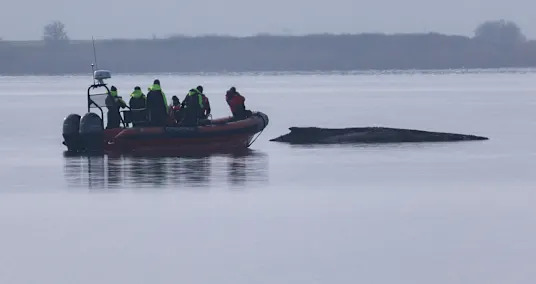
BERLIN (AP) — Rescuers said Wednesday that they have given up hope for the humpback whale that has become stranded repeatedly off Germany's Baltic Sea coast and now expect it to die in the inlet where it currently lies.
The whale swam into an inlet on the small island of Poel, near the port of Wismar, on Tuesday and got stuck again. Last week, it was rescued from even shallower water at Timmendorfer Strand, a resort town around 50 kilometers (over 30 miles) from its current location, with the help of an excavator, but it soon ran into trouble again.
In recent days, authorities have pursued a strategy of trying to give the exhausted mammal peace and quiet so that it can gather enough strength to swim away under its own steam, while sometimes approaching it with boats to motivate it to set off.
Burkard Baschek, the scientific director of the Ocean Museum Germany and the scientific coordinator of the rescue effort, said the whale was breathing at very irregular intervals on Wednesday and that drone photos showed little sign of activity in the sediment under the 12-15 meter (39-49 foot) animal. It barely reacted when approached.
The whale was a bit more active after rescuers left, “but it is not activity that gives us grounds for hope,” Baschek said at a televised news conference. “We firmly believe that the animal will die there.”
While the whale on two previous occasions was able to gather enough strength to free itself, it is now weaker and also faces falling water levels, “and the prospects that it will free itself are very small,” he said. “The approach of maximum rest and respect for nature demands at some point that we let it go.”
The drama captivated Germans, with the media sending detailed updates on its progress. The whale acquired the nickname “Timmy” during its coastal odyssey.
It was first spotted swimming in the region on March 3. It is not clear why the whale swam into the Baltic Sea, which is far from its natural habitat and it isn't suited to. Some experts say the animal may have lost its way when it swam after a shoal of herring, or during migration.
The animal always faced long odds to find its way out into the North Sea, itself a journey of several hundred kilometers (miles), and then to the Atlantic Ocean.
LATEST POSTS
- 1
 EU foreign ministers commemorate Russian massacre in Bucha
 - 2Exploring the Main Year of Life as a parent: Individual Encounters
- 3Interstellar comet 3I/ATLAS will fly by Earth Friday. Here are the latest images
- 4Italy's Beloved Trevi Fountain Hides A Unique Secret That Can Be Explored Underground
- 5'Dancing With the Stars' Season 34 finale: Who might win the mirror ball trophy? Where do the remaining contestants rank?



- Gaza humanitarian efforts reach key milestone as UNICEF vaccinates some 13,000 children
- US FDA grants market authorization to six on! PLUS nicotine pouch products
- ‘Wicked: For Good’ streaming release — How to watch the sequel starring Ariana Grande and Cynthia Erivo
- Agios Pharma shares jump as US FDA expands approval for its blood disorder drug
- Without evidence, CDC changes messaging on vaccines and autism
- Step by step instructions to Pick the Right Sunlight powered charger Type for Your Home
- New movies to watch this weekend: See 'The Running Man' in theaters, rent 'One Battle After Another,' stream 'Nobody 2' on Peacock
- New Cheetos and Doritos will be free of artificial dyes
- Exploring Asia’s Realm of Flying Snakes